





































































































What Does IP Rating Mean on a Light Fixture?
When shopping for a light fixture, you may notice a code such as IP20, IP44, IP54, IP65 or IP67 in the product specifications. These numbers can look technical, but they answer a simple and important question:
How well is the light fixture protected against dust, solid objects and water?
An IP rating, or Ingress Protection rating, is a standardised classification used to describe the protection provided by an electrical enclosure against the entry of solid foreign objects and water. The IP Code is defined by IEC 60529, an international standard for degrees of protection provided by electrical enclosures.
For lighting, understanding the IP rating is especially important when choosing fixtures for bathrooms, kitchens, balconies, gardens, patios, entrances and other areas exposed to moisture, rain, dust or water.
The key is to remember that the two numbers in an IP rating have different meanings.

What Does IP Rating Mean?
IP stands for Ingress Protection.
An IP rating normally consists of the letters IP followed by two numbers:
IP XY
- First digit (X): protection against solid objects and dust
- Second digit (Y): protection against water
For example, an IP65 light fixture has:
- 6 = dust-tight protection
- 5 = protection against water jets
Therefore, IP65 does not simply mean “waterproof.” It tells you specifically how the enclosure performed against defined forms of dust and water exposure under the applicable testing conditions.
The IP Code is a technical classification rather than a general marketing description such as “weatherproof.” The exact rating describes a particular degree of protection.
How Do You Read an IP Rating on a Light Fixture?
The easiest way to understand an IP rating is to separate the two digits.
The first digit: protection against solids and dust
The first number indicates protection against access to hazardous parts and the ingress of solid foreign objects.
The scale runs from 0 to 6:
| First digit | Protection level | Simple explanation |
|---|---|---|
| 0 | No protection | No specified protection |
| 1 | Large objects | Protection against large solid objects |
| 2 | Fingers | Protection against finger access |
| 3 | Tools | Protection against smaller tools/objects |
| 4 | Objects ≥1 mm | Protection against objects larger than 1 mm |
| 5 | Dust-protected | Limited dust ingress is permitted under the standard |
| 6 | Dust-tight | No dust ingress under the specified test conditions |
For most household lighting, the ratings you are likely to encounter include 2, 4, 5 and 6.
For example, the first digit in IP44 indicates protection against solid objects of at least 1 mm, while the first digit in IP65 indicates a dust-tight enclosure.
The second digit: protection against water
The second number describes protection against water.
The scale includes:
| Second digit | Protection level | Simple explanation |
|---|---|---|
| 0 | No protection | No specified water protection |
| 1 | Dripping water | Protection against vertically falling drops |
| 2 | Angled dripping | Protection against dripping water when tilted |
| 3 | Spraying water | Protection against spraying water |
| 4 | Splashing water | Protection against water splashes |
| 5 | Water jets | Protection against water jets |
| 6 | Powerful water jets | Protection against more powerful water jets |
| 7 | Temporary immersion | Protection against temporary immersion |
| 8 | Continuous immersion | Protection under conditions specified by the manufacturer/standard |
| 9 | High-pressure/high-temperature jets | Protection against specified high-pressure, high-temperature water jets |
This is why the second digit is particularly important for bathroom and outdoor lighting. The higher the number, the more demanding the water exposure the enclosure is designed to withstand.
However, a higher number does not automatically mean a fixture is suitable for every installation. The manufacturer’s instructions, mounting position, wiring, environment and applicable electrical requirements still need to be considered.
What Does IP20 Mean on a Light Fixture?
IP20 is a common rating for indoor lighting designed for relatively dry locations.
The 2 indicates protection against access with a finger, while the 0 means there is no specified protection against water.
In practical terms, an IP20 light is generally appropriate for dry indoor areas such as living rooms, bedrooms, hallways and other locations where the fixture is not expected to encounter water or significant moisture.
An IP20 fixture should not be selected simply because it looks attractive for a bathroom, balcony or exposed outdoor area. It does not have a rated level of water protection.
What Does IP44 Mean on a Light?
IP44 means:
- 4: protected against solid objects larger than 1 mm
- 4: protected against splashing water from different directions
IP44 is one of the most commonly encountered ratings for bathroom and sheltered outdoor lighting.
It can be appropriate for areas where a fixture may experience humidity, condensation or occasional splashes, depending on its exact location and the relevant installation requirements.
For example, IP44 may be suitable for certain:
- Bathroom wall lights
- Mirror lights
- Vanity lights
- Covered balconies
- Sheltered porches
- Protected entrances
But IP44 does not mean the fixture is submersible or suitable for direct water jets. It is splash-resistant protection, not immersion protection.
What Does IP54 Mean on a Light?
IP54 means:
- 5: dust-protected
- 4: protected against splashing water
Compared with IP44, IP54 provides a higher level of protection against dust while retaining the same level of water protection against splashes.
This can make IP54 useful for lighting installed in environments where both dust and moisture are concerns.
Examples can include certain:
- Utility areas
- Workshops
- Garages
- Sheltered outdoor spaces
- Commercial environments
- Dusty indoor areas
IP54 should not, however, be interpreted as protection against water jets or immersion.
What Does IP65 Mean on a Light Fixture?
IP65 means:
- 6: dust-tight
- 5: protected against water jets
This makes IP65 a popular choice for outdoor lighting and areas exposed to direct water spray.
IP65 fixtures are commonly considered for:
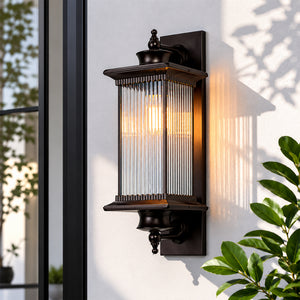
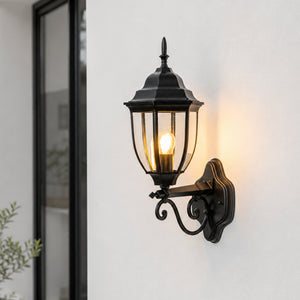
- Outdoor wall lights
- Garden lights
- Floodlights
- Exterior ceiling lights
- Driveway lighting
- Patio lighting
- Lights exposed to rain
- Bathroom lights exposed to direct shower spray
IP65 provides substantially greater protection than IP44 against both dust and water jets. However, IP65 does not mean that the fixture can be submerged in water. For immersion protection, a different rating such as IP67 or IP68 may be required, depending on the application.
What Does IP67 Mean on a Light Fixture?
IP67 means:
- 6: dust-tight
- 7: protected against temporary immersion in water under the specified test conditions
This is a higher level of water protection than IP65.
IP67 may be relevant to specialist lighting used where temporary immersion is possible, including certain landscape, pool-adjacent or ground-level applications.
But there is an important distinction:
IP67 does not simply mean “better IP65.”
IP65 is tested for water jets, whereas IP67 concerns temporary immersion. The two ratings address different water exposure conditions.
A fixture should therefore be selected according to the actual environment rather than choosing the largest number available.
IP44 vs IP65: Which Is Better?
There is no universal answer because IP44 and IP65 are designed for different exposure conditions.
| Rating | Solids | Water | Typical lighting application |
|---|---|---|---|
| IP20 | Basic protection | No water protection | Dry indoor areas |
| IP44 | Objects >1 mm | Water splashes | Bathrooms, sheltered areas |
| IP54 | Dust-protected | Water splashes | Dusty/damp environments |
| IP65 | Dust-tight | Water jets | Outdoor and wet/exposed areas |
| IP67 | Dust-tight | Temporary immersion | Specialist wet/ground-level applications |
If a light is installed in a covered, relatively protected location, IP44 may provide the appropriate level of protection.
If it is exposed to direct rain, water spray or a dusty outdoor environment, IP65 may be more appropriate.
The goal is not to choose the highest IP rating simply because it is higher. The goal is to choose a fixture whose protection matches the environment.
What IP Rating Do Bathroom Lights Need?
Bathroom lighting needs more careful consideration because fixtures can be exposed to steam, condensation, splashes and direct water spray.
The correct IP rating depends on the exact position of the light in relation to the bath, shower, basin and other water sources, as well as applicable local electrical regulations.
As a general product-selection guide:
- IP20: suitable only for genuinely dry locations where permitted
- IP44: commonly used for bathroom areas exposed to splashes
- IP65: a strong choice for areas exposed to direct shower spray
- IP67 or higher: relevant to specialised locations where temporary immersion can occur
Bathroom safety zones and minimum requirements can vary by country and electrical code, so an IP rating should not be used as a substitute for local installation requirements. Bathroom lighting guidance commonly divides the room into zones according to proximity to water.
For a new bathroom installation, always check the manufacturer’s instructions and consult a qualified electrician where required.
What IP Rating Is Best for Outdoor Lights?
For outdoor lighting, the right IP rating depends on how exposed the fixture is.
A covered porch or sheltered entrance may have significantly less exposure than a wall that receives direct rain throughout the year.
As a practical starting point:
- IP44: suitable for some sheltered outdoor locations
- IP54: useful where dust and splashing are concerns
- IP65: a common choice for exposed outdoor lighting
- IP67: appropriate for applications where temporary immersion may occur, provided the complete fixture is designed for that application
Outdoor conditions can include more than rain. Consider dust, wind-driven water, irrigation, cleaning, humidity and the possibility of water pooling around the fitting.
Also remember that IP rating is not a complete measure of outdoor durability. Material quality, UV resistance, corrosion resistance, temperature range, cable entries and installation quality can also affect how well a light performs outdoors.
Outdoor IP Ratings by Fixture Type and Position
Two outdoor lights in the same garden can reasonably need different IP ratings, because “outdoor” covers a wide range of exposure — from a wall lamp tucked under a covered porch to a spotlight sitting in a flower bed that puddles after rain. It’s more useful to think in terms of fixture position than “indoor vs outdoor” alone:
| Outdoor fixture type | Typical position | Commonly recommended IP rating | Why |
|---|---|---|---|
| Porch, eaves or covered entrance lights | Sheltered, under an overhang | IP44 | Reduced direct rain exposure; still needs splash protection from wind-blown moisture and condensation |
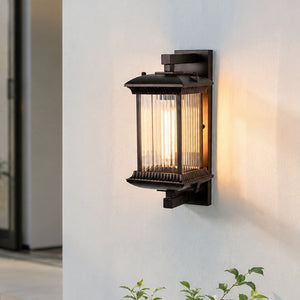
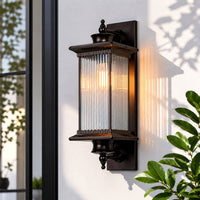
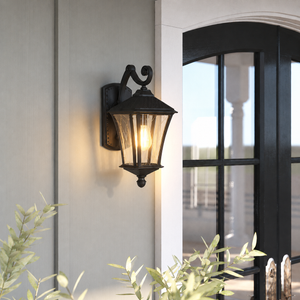
| Exterior wall lights, wall lanterns | Exposed wall surface, no overhang | IP65 | Full exposure to rain, wind-driven water and occasional hose or sprinkler spray |
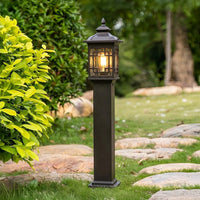
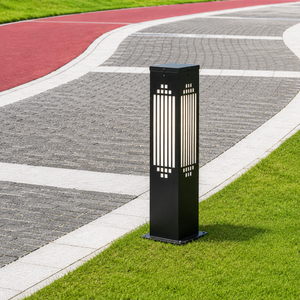
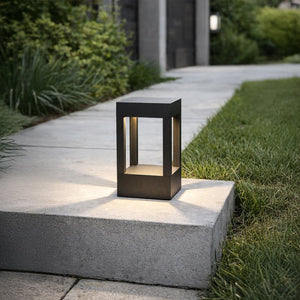
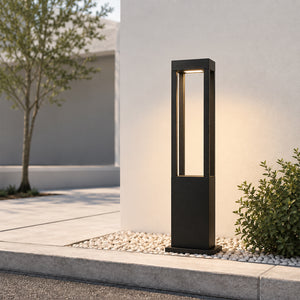
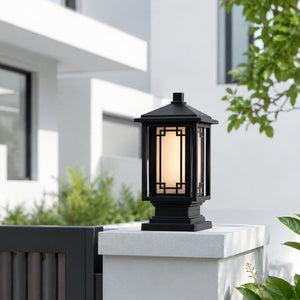
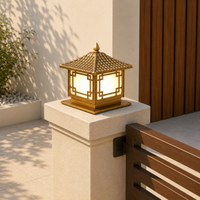
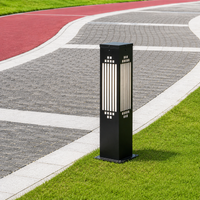
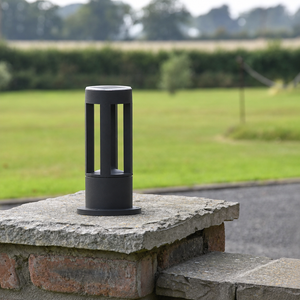
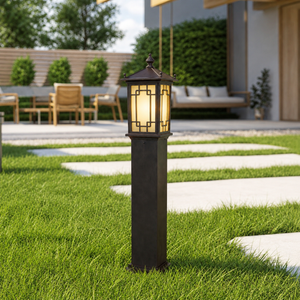
| Bollard lights, pillar lights, pathway and driveway lights | Ground-level, freestanding | IP65 (often IP66/67 for taller or fully exposed installations) | Direct rain from above and splashback from ground level; higher exposure than a wall-mounted fixture at the same location |
| Floodlights and security lights | Mounted high, fully exposed | IP65–IP66 | Wind-driven rain hits elevated, exposed fixtures with more force than ground-level ones |
| Recessed deck lights, step lights, in-ground/well lights, garden spike lights | At or below ground level | IP67 | Ground-level fittings can sit in puddles or temporary standing water after heavy rain, even if they’re never fully submerged long-term |
| Pond, fountain and swimming pool lighting | Continuously underwater | IP68 | Only IP68 is tested for continuous, pressurised submersion — the rating specifically required for permanently underwater fixtures |
A few points worth keeping in mind when applying this table:
- Height and exposure direction matter, not just “indoor vs outdoor.” A fixture mounted high on an exposed facade can face wind-driven rain hitting with considerably more force than the same fixture at ground level or under cover — which is why exposed wall lights and floodlights are commonly specified at IP65–IP66 even though a sheltered porch light nearby might only need IP44.
- Ground-level and in-ground fixtures are held to a higher standard than most wall lights, because rain naturally pools at ground level even where drainage is reasonably good. This is why bollards, path lights and recessed deck or step lights are typically specified at IP65–IP67 rather than IP44.
- IP68 is a distinct category from IP65/IP67, not just “the next number up.” It’s reserved for fixtures designed for continuous submersion under pressure — pond, fountain and pool lighting — and shouldn’t be assumed to apply to general garden or wall lighting.
- Low-voltage transformers, drivers and connectors used in outdoor lighting systems need their own outdoor-rated enclosure — commonly IP65 or higher — separate from the IP rating of the light fixture itself. A well-rated fixture connected to an unrated indoor transformer or an unsealed connector left exposed in a flower bed is still a weak point in the system.
- Local electrical regulations still apply. Outdoor and garden lighting circuits, especially anything low-voltage or near water features, are commonly subject to specific wiring and installation requirements — an IP rating is about the fixture’s enclosure, not a substitute for correct electrical installation.
Is a Higher IP Rating Always Better?
Not necessarily.
A higher IP rating provides greater protection against particular forms of ingress, but the “best” rating depends on where the fixture will be installed.
For example, installing an IP65 light in a completely dry bedroom may provide protection you do not need.
On the other hand, installing an IP20 fitting in an exposed outdoor location would provide inadequate water protection.
Choosing the correct rating is therefore about matching the fixture to the environment, not simply selecting the highest number.
A more highly sealed fixture can also have different design, thermal-management or installation characteristics. Always check the complete product specification.
Is IP65 Waterproof?
The safest answer is:
IP65 is water-jet resistant under the specified test conditions, but it is not a submersion rating.
Calling every IP65 light “waterproof” can create the wrong expectation.
IP65 indicates:
- Dust-tight protection
- Protection against water jets
It does not indicate that the fixture can be continuously submerged.
If a fixture could be exposed to standing water or temporary immersion, look for a product specifically rated for that application, such as an appropriate IP67 or IP68 fixture, and follow the manufacturer’s installation instructions.
What Does IPX4 or IPX5 Mean?
Sometimes you may see an X instead of a number, such as IPX4 or IPX5.
The X means that the corresponding characteristic has not been specified in the IP code.
For example:
- IPX4 = water-splash protection is specified, while the solid-object characteristic is not specified
- IPX5 = water-jet protection is specified, while the solid-object characteristic is not specified
The IP Code allows an X to replace a characteristic numeral when that characteristic is not required to be specified.
Does IP Rating Affect the Brightness of a Light?
No.
An IP rating does not tell you how bright a light is.
It also does not directly tell you:
- Wattage
- Lumens
- Colour temperature
- Colour Rendering Index (CRI)
- Beam angle
- Energy efficiency
- Light quality
- Colour
- Style
For example, two IP65 LED lights can have completely different brightness levels, colour temperatures and designs.
When choosing a light fixture, consider IP rating and lighting performance separately.
For example, if you are choosing a bathroom wall light, you may need to consider both its IP rating and whether it provides comfortable, useful illumination around the mirror.
Why Does IP Rating Matter When Buying a Light Fixture?
Choosing the correct IP rating helps ensure that the light fixture is appropriate for its environment.
An unsuitable rating can contribute to problems when a fitting is exposed to conditions beyond what its enclosure is designed to handle.
The IP rating is particularly useful when shopping for:
- Bathroom lights
- Outdoor wall lights
- Garden lights
- Balcony lights
- Patio lights
- Shower lights
- Kitchen lights
- Garage lights
- Pool-area lighting
- Landscape lighting
- LED strip lighting
Instead of asking only “Does this light look good?”, consider asking:
“Where will I install it, and what will it be exposed to?”
That question makes choosing the right IP rating much easier.
How to Choose the Right IP Rating for Your Light
Before purchasing a light fixture, follow these five steps.
1. Identify the location
Is the fixture going in a bedroom, bathroom, balcony, garden, porch, kitchen or completely exposed outdoor area?
2. Consider water exposure
Could the light encounter:
- Humidity?
- Steam?
- Occasional splashes?
- Direct rain?
- Water jets?
- Standing water?
- Temporary immersion?
3. Consider dust exposure
A dusty garage, workshop or garden may require greater protection against solid particles than a clean indoor living space.
4. Check the complete product specification
Do not rely solely on a product title containing words such as “waterproof” or “weatherproof.”
Look for the actual IP code in the technical specifications and verify that the fixture is intended for your particular application.
5. Follow installation requirements
Even a correctly rated fixture can be unsuitable if it is incorrectly installed.
Pay attention to:
- Mounting orientation
- Cable entry
- Seals and gaskets
- Driver location
- Electrical connections
- Drainage
- Manufacturer instructions
- Local electrical regulations
For bathrooms and other wet areas, professional electrical advice may be necessary.
Quick Guide: Common IP Ratings for Light Fixtures
If you only need a quick reference, remember:
IP20: Dry indoor lighting with no rated water protection.
IP44: Protection against splashing water; commonly encountered in bathrooms and sheltered areas.
IP54: Dust-protected and splash-resistant.
IP65: Dust-tight and protected against water jets; commonly used for exposed outdoor and wet-area lighting.
IP67: Dust-tight and protected against temporary immersion under specified conditions.
IP68: Dust-tight and protected against continuous, pressurised immersion; the rating used for permanently submerged fixtures such as pond, fountain and pool lighting.
The correct choice depends on the actual installation environment, not simply on which rating has the highest number.
Frequently Asked Questions About IP Ratings on Light Fixtures
What does IP rating mean on a light fixture?
An IP rating tells you how well a light fixture’s enclosure is protected against solid objects, dust and water. The first digit describes protection against solids, while the second digit describes protection against water.
What is the most common IP rating for indoor lights?
Many standard indoor light fixtures use IP20, particularly in dry rooms. However, the correct rating depends on the location and product design.
Is IP44 suitable for bathroom lights?
IP44 is commonly used for bathroom lighting in areas where splash protection is appropriate. The exact required rating depends on the fixture’s position and applicable local electrical requirements.
Is IP65 suitable for outdoor lights?
IP65 is a common choice for outdoor lighting because it provides dust-tight protection and protection against water jets. The fixture must still be designed and installed for outdoor use.
Is IP65 better than IP44?
IP65 provides greater protection against dust and water jets than IP44. However, that does not mean IP65 is automatically the right choice for every installation.
Is IP67 waterproof?
IP67 provides protection against temporary immersion under specified test conditions. It should not be interpreted as unlimited or permanent underwater protection.
What IP rating do pond, fountain or pool lights need?
Lighting that is continuously submerged — such as pond, fountain or swimming pool lighting — needs an IP68 rating. IP68 is tested for sustained, pressurised immersion, which is a materially different condition from the temporary immersion covered by IP67, so a lower rating shouldn’t be substituted for permanently underwater fixtures.
Do outdoor lighting transformers and drivers need an IP rating too?
Yes. In low-voltage outdoor lighting systems, the transformer, driver and any exposed connectors need their own outdoor-rated enclosure — commonly IP65 or higher — separate from the IP rating of the light fixture itself. A well-sealed fixture connected to an unrated or indoor-only transformer left exposed outside is still a point of failure in the system.
Can I use an IP20 light in a bathroom?
An IP20 fixture has no rated protection against water. It should not be selected for locations where water or splashing can reach the fitting unless the applicable installation requirements specifically permit it.
Does a higher IP rating make a light better?
A higher IP rating means greater protection against particular types of ingress, but it does not automatically mean the fixture is better overall. The correct IP rating is the one that matches the environment.
Final Takeaway
The IP rating on a light fixture tells you how well its enclosure protects against solids and water.
The easiest way to remember the system is:
First digit = solids and dust. Second digit = water.
So:
- IP20 = basic indoor protection, no rated water protection
- IP44 = splash protection
- IP54 = dust-protected and splash-resistant
- IP65 = dust-tight and water-jet resistant
- IP67 = dust-tight and protected against temporary immersion
- IP68 = dust-tight and protected against continuous, pressurised immersion
When choosing lighting for your home, don’t select an IP rating based solely on the highest number. Think about the actual environment, the amount of moisture or dust the fixture will encounter, its exact position, and the manufacturer’s installation requirements.
For bathrooms and outdoor spaces especially — and for outdoor fixtures in particular, where exposure can range from a covered porch to a submerged pond light — the right IP rating is an important part of choosing a light fixture that is suitable for the space.